
Capitol Hill is experiencing one of its most turbulent and fast-moving legislative seasons in recent history.As the 119th United States Congress tackles deep partisan divides, soaring inflation, and mounting geopolitical tensions, lawmakers have recently passed several monumental decisions that will reshape both domestic policy and international relations for years to come.
From a historic rebuke of executive military overreach to massive national security spending and critical intelligence updates, the decisions coming out of Washington D.C.are dominating search engines.
For everyday Americans, investors, and political analysts alike, keeping up with these legislative shifts is vital.Here is a comprehensive, in-depth breakdown of the most critical new decisions passed by the US Congress, their underlying political battles, and how they impact the nation.
1.The Historic House Vote: Passing the War Powers Resolution on Iran
In a stunning legislative development that sent shockwaves through the White House, the U.S.House of Representatives officially passed a war powers resolution aimed at halting ongoing military actions against Iran.
The Political Battle Over Commander-in-Chief Authority
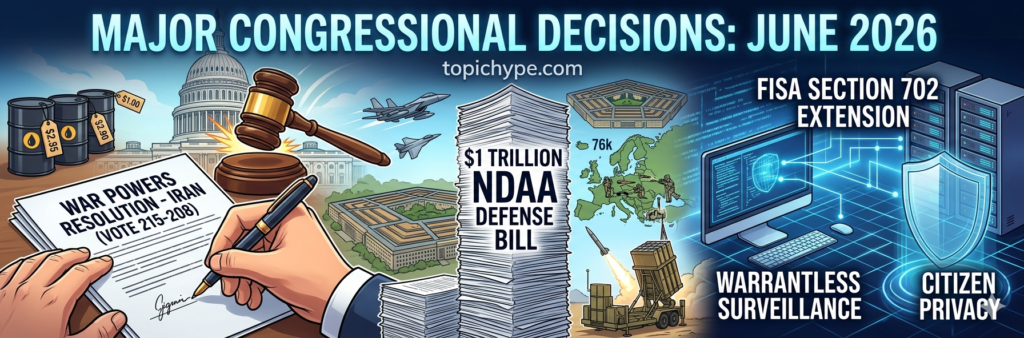
Led by House Foreign Affairs Committee Democrats and bolstered by a handful of dissident Republicans, the resolution cleared the lower chamber with a razor-thin 215-208 vote.Under the historic 1973 War Powers Resolution, a sitting U.S.President can legally commit armed forces to combat for up to 60 days without explicit congressional approval.Beyond that threshold, lawmakers must step in with a formal declaration of war or direct authorization.
Because limited strikes between the U.S.and Iranian forces have flared continuously over a three-month period, lawmakers argued that the administration’s window for unchecked military action had officially expired.
Cross-Party Defections and Economic Strain
https://topichype.com/iran-conflict-tensions-2026/The vote represented a significant political hurdle for House leadership.Speaker of the House Mike Johnson had previously attempted to block the floor action to prevent showing fractures within the party, arguing that limiting executive military authority “weakens us” on the global stage.However, four Republican representatives broke ranks to vote alongside Democrats.
The driving force behind this pushback isn’t just constitutional law,it is also heavily driven by domestic economic strain.The maritime conflict has severely disrupted shipping through the Strait of Hormuz, causing severe spikes in global oil and natural gas prices.Lawmakers noted that American citizens are actively suffering at the gas pumps and grocery stores due to what they termed an unsustainable conflict.
While the resolution now heads to the Senate,which previously advanced a similar measure,the White House is expected to challenge any legislative attempts to curb commander-in-chief authorities.
2.Setting Records: The $1 Trillion National Defense Authorization Act (NDAA)
While Congress remains deeply divided over active military engagements, there is broad bipartisan consensus when it comes to long-term military funding.The U.S.House of Representatives overwhelmingly approved the 2026 National Defense Authorization Act (NDAA), pushing the annual Pentagon policy budget to a near-historic $1 trillion mark.
What is Inside the 2026 Defense Budget?
The passing of the 2026 NDAA ensures that Congress maintains its uninterrupted 65-year streak of successfully passing the annual military framework.This year’s trillion-dollar package heavily prioritizes troop welfare, technological modernization, and geopolitical deterrence:
- Troop Compensation & Welfare: The bill authorizes comprehensive boosts to troop base pay, along with heavily upgraded funding allocations for military housing structures and targeted healthcare programs.
- The European Defense Shield: In a direct message to global adversaries, the bill mandates that U.S.troop levels in Europe cannot drop below 76,000 active personnel.It also features an explicit $800 million aid package spanning over two years earmarked for strategic support in Ukraine, alongside extended security infrastructure investments across the Baltic states.
- Middle East Missile Defense: The framework guarantees absolute, full financial backing for Israel’s premier air defense grids, specifically ensuring the replenishment of the Iron Dome and David’s Sling defensive systems.
The NDAA now shifts over to the Senate floor, where lawmakers are expected to hammer out final adjustments regarding targeted social policy riders before sending the massive spending package to the President’s desk.
3.Security vs.Privacy: The Critical FISA Section 702 Extension
One of the most intensely debated legislative battles on Capitol Hill centers around national surveillance.Congress recently pushed through crucial temporary adjustments regarding Section 702 of the Foreign Intelligence Surveillance Act (FISA).
FISA Section 702 Overview:
Allows warrantless surveillance of foreign targets
Bipartisan Concern: Accidental capture of US citizens’
private digital communications.
Section 702 permits federal intelligence agencies to conduct targeted, warrantless electronic surveillance on foreign individuals residing outside the United States.However, a major point of contention among both civil liberties advocates and conservative lawmakers is the accidental sweep and collection of domestic American citizens’ digital communications.
Because a long-term, durable compromise framework couldn’t be reached due to these privacy concerns, Congress passed temporary, fast-tracked extensions to keep the program operational while negotiations continue behind closed doors.Intelligence agencies view this tool as absolutely vital to preempting cyberattacks and foreign threats, ensuring this remains a top-tier legislative focus throughout the month.
4.Domestic Policy Focus: The Push for Housing Affordability
Away from global battlefields and security apparatuses, the daily financial realities of average Americans are taking center stage in the form of sweeping Housing Affordability Legislation.
With the combined pressure of lingering inflation and high mortgage rates sidelining millions of potential homebuyers, both the House and the Senate have overwhelmingly advanced respective legislative packages aimed at stabilizing the market.
Key Frameworks of the Housing Affordability Initiatives:
- Permitting and Financing Reform: The core of the bipartisan bills focuses heavily on stripping away bureaucratic red tape, simplifying local permitting processes, and creating streamlined pathways for developer financing.
- Expanding Low-Income Inventory: Financial incentives are being restructured to explicitly encourage the rapid construction of single-family affordable homes and multi-family rental units.
- Addressing the Political Stakes: With crucial upcoming election cycles on the horizon, housing affordability has mutated into a primary kitchen-table issue.Lawmakers from both parties recognize that providing tangible relief to renters and first-time buyers is non-negotiable for political survival.
Summary Table: Major 2026 Congressional Decisions at a Glance
| Legislation / Action | Core Objective | Current Status | Primary Impact |
| War Powers Resolution | Halt military action against Iran without Congress approval. | Passed House (215-208). | Aims to cool regional conflict & stabilize gas prices. |
| NDAA 2026 | $1 Trillion annual military and defense funding bill. | Passed House; Sent to Senate. | Boosts troop pay; solidifies foreign aid to Ukraine/Israel. |
| FISA Section 702 | Warrantless surveillance of foreign threats. | Undergoing short-term extensions. | Balances counter-terrorism intelligence with citizen privacy. |
| Housing Legislation | Combat soaring housing costs and mortgage rates. | House & Senate reconciling versions. | Eases construction permitting to boost housing inventory. |
Final Thoughts: The Road Ahead for the 119th Congress
The aggressive legislative pushes seen in early June 2026 underscore a Congress under immense pressure.Whether it is checking executive war power, debating the fine lines of digital privacy, or attempting to engineer relief for the real estate market, the decisions made inside the Capitol building are drastically altering the country’s course.
As the appropriations process begins to heat up over the coming weeks, we can expect even more fierce debates surrounding government spending caps, healthcare oversight, and federal border security allocations.
What do you think about Congress’s decision to limit military actions? Do you think the new housing bill will successfully lower costs? Let us know your thoughts in the comments section below!