
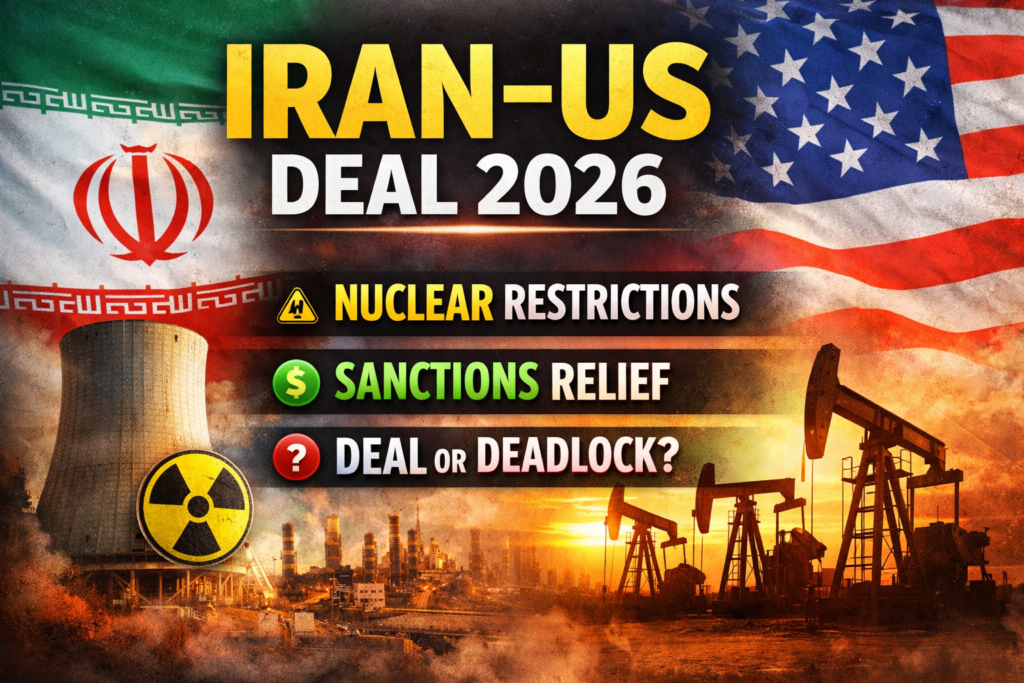
The ongoing tensions between Iran and the United States have once again brought the possibility of a renewed nuclear deal into global focus. With negotiations continuing but no final agreement reached, many are asking: What exactly does the Iran–US deal involve?
This article breaks down the core conditions in simple terms — including nuclear restrictions, sanctions relief, and the key challenges preventing a final agreement.
☢️ 1. Nuclear Program Restrictions
At the heart of the deal is Iran’s commitment to limit its nuclear activities.
✔️ Uranium Enrichment Limits
Iran agrees to restrict uranium enrichment to low levels (around 3–4%), suitable for civilian energy but far below weapons-grade levels (90%).
✔️ Stockpile Reduction
Iran must keep its enriched uranium stockpile under a strict limit (approximately 300 kg), reducing the risk of rapid weapon development.
✔️ Centrifuge Reduction
The number of centrifuges (machines used to enrich uranium) is significantly reduced to slow down nuclear progress.
✔️ No Nuclear Weapons
Iran formally commits to not developing or acquiring nuclear weapons.
🔍 2. International Monitoring
To ensure compliance, inspections are conducted by the
International Atomic Energy Agency (IAEA)
- Regular inspections of nuclear facilities
- Monitoring of uranium production
- Verification of compliance with the agreement
This transparency is crucial for building international trust.
💰 3. Sanctions Relief
In exchange for nuclear restrictions, the United States and its allies offer economic relief.
✔️ Lifting Economic Sanctions
- Iran can export oil globally
- Access to international banking systems is restored
- Frozen financial assets may be released
✔️ Trade & Investment Opportunities
- Foreign companies can invest in Iran’s economy
- Energy sector growth becomes possible
👉 This relief is essential for boosting Iran’s struggling economy.
⚖️ 4. Snapback Mechanism
A key feature of the deal is the “snapback” clause:
- If Iran violates the agreement
- Sanctions can be quickly reimposed
This ensures accountability and discourages non-compliance.
⏳ 5. Time Limits (Sunset Clauses)
Many restrictions are not permanent:
- Most nuclear limits last between 10–15 years
- Some monitoring measures continue longer
This has been a major concern for critics, who fear long-term risks once restrictions expire.
⚠️ 6. Why the Deal Is Still Stuck (2026)
Despite ongoing talks, several disagreements remain:
🔴 United States Concerns
- Wants stricter and longer-lasting nuclear limits
- Seeks restrictions on Iran’s missile program
- Concerned about Iran’s regional influence
🔴 Iran’s Demands
- Full and immediate sanctions relief
- Recognition of its right to peaceful nuclear activity
- Guarantees that future US administrations will not withdraw from the deal
🌍 Conclusion
The Iran–US deal is built on a simple but delicate balance:
👉 Nuclear restrictions in exchange for economic relief
However, deep mistrust and conflicting demands continue to block a final agreement. While diplomacy is still ongoing, the situation remains uncertain — with both risks of escalation and hopes for resolution.
- Iran limits nuclear activity and allows inspections
- The US lifts sanctions and restores economic access
- Violations trigger immediate sanctions return
- Major disagreements are still preventing a final deal