
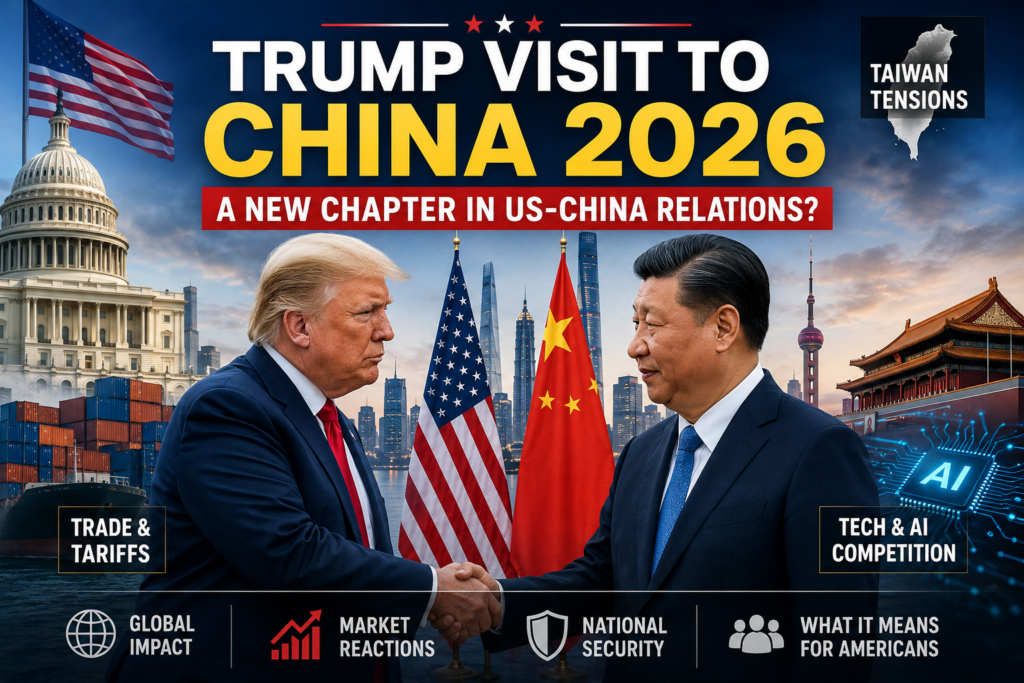
Trump Visit to China 2026: Why the Entire World Is Watching Closely
The world’s two biggest superpowers are back in the spotlight.
As reports surrounding President Donald Trump’s 2026 visit to China continue to dominate headlines, political analysts, economists, investors, and ordinary Americans are all asking the same question:
Could this meeting reshape the future of the global economy and international politics?
At a time when tensions between the United States and China remain high over trade, artificial intelligence, military expansion, and the future of Taiwan, this visit is more than just another diplomatic event. It could become one of the defining geopolitical moments of the decade.
For years, the relationship between Washington and Beijing has been filled with uncertainty. Tariffs, sanctions, supply chain disruptions, semiconductor restrictions, and military tensions in the South China Sea have created an atmosphere of rivalry rather than cooperation.
Now, Trump’s return to direct diplomacy with Chinese leadership has triggered massive reactions across financial markets, global media, and political circles.
Some believe the visit could stabilize the world economy.
Others fear it may deepen divisions between the world’s two largest powers.
Either way, the stakes could not be higher.
Why Trump’s China Visit Matters So Much
When a U.S. president visits China, global markets pay attention immediately. But this particular visit carries extra weight because of the current international climate.
The United States and China together account for nearly 40% of the global economy. Any improvement — or deterioration — in their relationship impacts everything from inflation and manufacturing to technology and oil prices.
Trump’s political style also adds another layer of unpredictability.
Unlike traditional diplomats, Trump is known for direct negotiations, aggressive bargaining tactics, and headline-making decisions. During his previous presidency, he launched one of the biggest trade wars in modern history by imposing hundreds of billions of dollars in tariffs on Chinese imports.
Those tariffs reshaped supply chains worldwide.
American companies began shifting factories out of China. Tech firms started preparing for economic decoupling. Investors became nervous about long-term instability between the two countries.
Now, in 2026, many analysts believe Trump’s visit could signal either:
- A major economic reset
- A new trade agreement
- Or an even tougher stance against Beijing
That uncertainty alone is driving enormous online interest and search traffic.
The Trade War Is Still a Massive Issue
One of the biggest topics surrounding Trump’s visit is the ongoing U.S.-China trade conflict.
The original trade war began during Trump’s first presidency when the U.S. accused China of:
- Unfair trade practices
- Intellectual property theft
- Currency manipulation
- Forcing American companies to share technology
In response, the United States imposed tariffs on hundreds of billions of dollars worth of Chinese goods.
China retaliated with its own tariffs on American products.
The result?
American consumers faced higher prices, global businesses struggled with uncertainty, and supply chains across industries became unstable.
Even years later, many of those tariffs remain in place.
Now investors and businesses are closely watching whether Trump’s China visit could lead to:
- Reduced tariffs
- New trade agreements
- Tougher restrictions
- Or a complete restructuring of economic ties
For American families, these decisions matter directly.
Tariffs influence:
- Grocery prices
- Electronics costs
- Car prices
- Manufacturing jobs
- Inflation rates
If tensions ease, prices could stabilize in some sectors.
If tensions escalate, Americans could face another wave of higher costs.
Taiwan Could Become the Most Sensitive Topic
Another major issue hanging over the visit is Taiwan.
Taiwan remains one of the most dangerous geopolitical flashpoints in the world today.
China considers Taiwan part of its territory and has repeatedly stated that reunification is inevitable. Meanwhile, the United States continues supporting Taiwan militarily and politically.
Over the last few years:
- Chinese military activity near Taiwan increased dramatically
- U.S. naval operations intensified
- Global fears of military confrontation grew
Any direct conflict involving Taiwan could trigger:
- Global economic collapse
- Massive military escalation
- Semiconductor shortages
- Worldwide market panic
Why semiconductors matter so much:
Taiwan produces a huge percentage of the world’s advanced computer chips. These chips power:
- Smartphones
- AI systems
- Cars
- Military equipment
- Data centers
A Taiwan crisis would affect nearly every American household and business.
That’s why experts believe Taiwan discussions may quietly dominate Trump’s China visit behind closed doors.
AI and Technology Competition Is Heating Up
Artificial intelligence has become the new battlefield between America and China.
The AI race is no longer just about technology.
It is about:
- Military dominance
- Economic leadership
- Cybersecurity
- Global influence
The United States currently leads in advanced AI development through companies like OpenAI, Google, and Microsoft.
Meanwhile, China is investing hundreds of billions into:
- AI infrastructure
- Semiconductor manufacturing
- Quantum computing
- Robotics
- Surveillance technologies
Washington has already placed restrictions on exporting advanced AI chips to China. American officials worry these technologies could strengthen China’s military capabilities.
Trump’s visit may determine whether:
- Tech tensions worsen
- New export restrictions emerge
- Or negotiations reduce the risk of a full technological cold war
For Americans, this competition affects:
- Jobs
- Innovation
- National security
- The future of the economy
Global Markets Reacted Immediately
Financial markets hate uncertainty.
Whenever major geopolitical developments occur between the U.S. and China, investors react fast.
Following reports of Trump’s China visit:
- Asian markets showed volatility
- U.S. futures fluctuated
- Oil prices moved sharply
- Tech stocks gained increased attention
Why?
Because global investors understand how deeply interconnected the two economies remain.
If negotiations go well:
- Markets may rally
- Manufacturing confidence could improve
- Supply chain fears might ease
But if tensions rise:
- Stock markets could fall
- Inflation concerns may increase
- Energy prices might surge again
Major sectors being watched closely include:
- Technology
- Semiconductors
- Manufacturing
- Energy
- Shipping
- Defense companies
What This Means for Ordinary Americans
Many people hear “U.S.-China relations” and assume it only matters to politicians.
That’s no longer true.
The relationship between America and China affects everyday life in ways most people don’t realize.
For example:
- Smartphone prices depend on Chinese manufacturing
- Grocery costs are influenced by trade policies
- Retirement accounts react to stock market volatility
- Gas prices respond to global instability
If tensions worsen:
- Inflation could rise
- Consumer goods may become more expensive
- Supply shortages could return
If relations improve:
- Markets may stabilize
- Businesses could regain confidence
- Prices might cool in certain industries
That’s why millions of Americans are paying attention to this visit even if they normally avoid politics.
Could Trump Actually Change U.S.-China Relations?
Supporters of Trump argue that his aggressive negotiation style gives America leverage.
Critics argue his unpredictability creates instability.
Regardless of political opinion, one fact is clear:
Trump dramatically changed America’s relationship with China during his presidency.
Before Trump, many U.S. leaders focused heavily on economic cooperation with Beijing.
Trump shifted the conversation toward:
- National security
- Economic independence
- Manufacturing protection
- Technology competition
His policies pushed many American companies to rethink dependence on China.
Now, the question is whether Trump’s 2026 visit signals:
- Renewed cooperation
- Strategic competition
- Or a deeper economic split
China’s Perspective on the Visit
From Beijing’s viewpoint, the meeting also carries major importance.
China faces several domestic challenges:
- Slower economic growth
- Real estate instability
- Youth unemployment concerns
- International pressure from Western countries
Improved relations with the United States could help stabilize investor confidence and global trade.
At the same time, China does not want to appear weak internationally.
That creates a delicate balancing act.
Chinese leadership likely hopes to:
- Reduce economic pressure
- Prevent further tariffs
- Avoid military escalation
- Maintain access to global markets
But they also want to protect national pride and strategic interests.
This is why analysts expect negotiations to be extremely complicated.
Oil Prices and Energy Markets Could Shift
Another overlooked factor is energy.
Any increase in geopolitical tension involving China can influence:
- Oil prices
- Shipping routes
- Energy security
China is one of the world’s largest energy consumers.
If relations between Washington and Beijing deteriorate, energy markets could become volatile again.
Higher oil prices would impact Americans directly through:
- Gasoline costs
- Airline prices
- Shipping fees
- Food transportation expenses
Even rumors surrounding diplomatic negotiations can move global energy markets within hours.
America’s Allies Are Watching Carefully
Trump’s China visit is not only important for America and China.
Countries around the world are watching closely, including:
- Japan
- South Korea
- India
- European nations
- Middle Eastern allies
Why?
Because global alliances may shift depending on the outcome of these discussions.
If U.S.-China tensions improve:
- International trade could strengthen
- Diplomatic cooperation may increase
If tensions worsen:
- Countries may be forced to choose sides
- Military spending could rise globally
- Economic fragmentation may accelerate
This is why geopolitical analysts describe the visit as a possible turning point for the international order.
Could This Impact the 2026 U.S. Election Climate?
Foreign policy often influences domestic politics more than expected.
If Trump’s China visit is viewed positively:
- Supporters may see him as a strong negotiator
- Markets could respond favorably
- Economic confidence might improve
But if negotiations fail:
- Critics may attack his foreign policy strategy
- Investors could become nervous
- Media scrutiny may intensify
Because China remains one of America’s biggest strategic competitors, every diplomatic move carries political consequences.
Future Predictions: What Happens Next?
Several possible outcomes could emerge from Trump’s visit.
Scenario 1: Economic Cooperation Improves
The two countries may reach limited agreements on:
- Trade
- Tariffs
- Technology
- Manufacturing
This would likely calm markets temporarily.
Scenario 2: Strategic Rivalry Continues
Both sides may maintain competition while avoiding direct confrontation.
Many experts believe this is the most realistic scenario.
Scenario 3: Tensions Escalate
If negotiations break down:
- Tariffs could increase
- Tech restrictions may expand
- Military tensions could rise
This would create serious global uncertainty.
Why This Story Is Dominating Online Searches
There’s a reason this topic is generating massive traffic online.
It combines:
- Politics
- Money
- War fears
- Technology
- Global power struggles
- Economic uncertainty
These are exactly the types of stories that dominate:
- Google Discover
- YouTube trends
- Social media discussions
- News search results
People want answers because the consequences could affect the entire world.
Final Thoughts
Trump’s 2026 visit to China is far more than a diplomatic photo opportunity.
It represents a critical moment in the future relationship between the world’s two largest superpowers.
The decisions made during this visit could influence:
- Global markets
- Inflation
- Technology leadership
- Military stability
- International alliances
- Everyday American life
Whether the meeting leads to cooperation or deeper rivalry, one thing is certain:
The world will be watching every move carefully.
As geopolitical tensions continue shaping the global economy, Americans should pay close attention to how these negotiations evolve — because their impact could reach far beyond politics and directly into homes, businesses, and financial markets across the country.
FAQs
Why is Trump’s visit to China important?
Because the United States and China are the world’s two largest economies, any major diplomatic meeting between them can impact trade, markets, inflation, and global stability.
Could Trump reduce tariffs on China?
It’s possible. Analysts believe trade negotiations may include discussions about reducing or adjusting tariffs.
Why is Taiwan such a major issue?
Taiwan is one of the biggest geopolitical flashpoints in the world. A conflict there could disrupt global trade and semiconductor production.
How does this affect ordinary Americans?
U.S.-China relations influence prices, jobs, supply chains, gas costs, and stock market performance.
What industries are most affected?
Technology, manufacturing, energy, shipping, semiconductors, and retail industries are especially sensitive to U.S.-China tensions.
Could this visit improve the global economy?
If negotiations ease tensions and improve trade cooperation, markets and investor confidence could strengthen worldwide.