
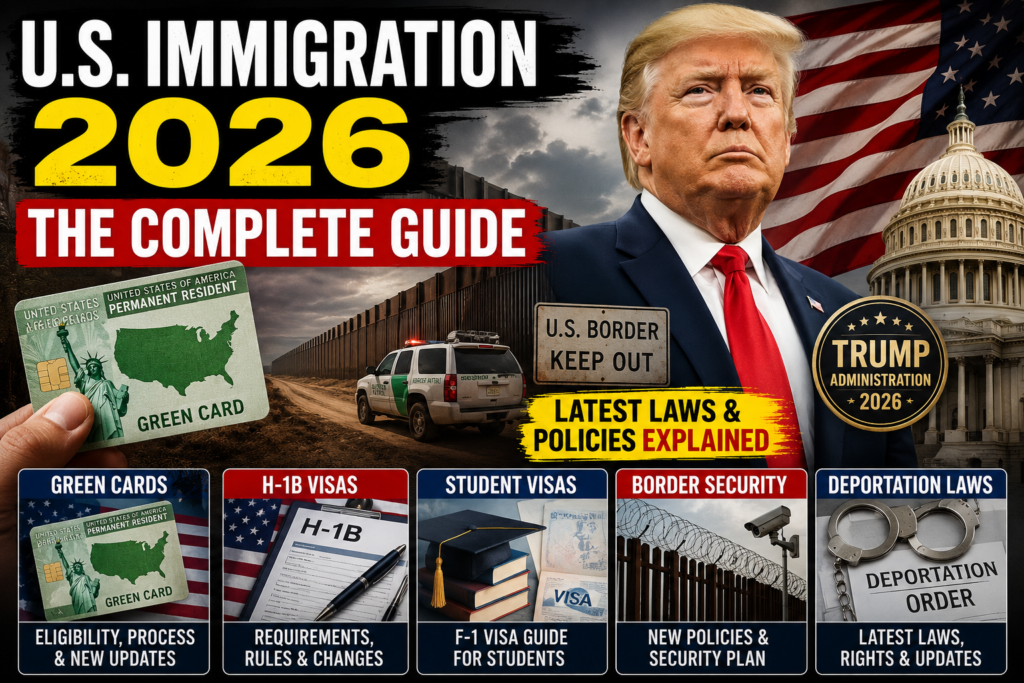
Everything Immigrants, Workers, Students, and Families Need to Know About America’s Rapidly Changing Immigration System in 2026
There is no topic in American life right now that touches more people . and generates more fear, confusion, and urgency . than immigration.Whether you are a skilled worker on an H-1B visa nervously watching Congress debate new restrictions, a college student on an F-1 visa afraid to travel home for summer break, a family waiting years for a green card that seems perpetually out of reach, or an undocumented immigrant who has built a life in this country and now wakes up every morning uncertain about the future . the changes happening to U.S.immigration law and enforcement in 2026 are not abstract.They are personal.They are immediate.And they are moving fast.
The Trump administration entered its second term with a sweeping mandate to reshape American immigration, and it has wasted no time doing exactly that.From executive orders that took effect on January 1, 2026, to new legislation being debated in Congress, to dramatically intensified enforcement at the border and inside the country, the immigration landscape in America has shifted more significantly in the last eighteen months than it did in the previous decade combined.This guide is designed to cut through the noise and give you a clear, accurate, comprehensive picture of where things stand . on green cards, H-1B visas, student visas, border security, and deportation laws . and what it means for you.
Green Cards in 2026: Longer Waits, New Restrictions, and What Has Changed
A green card . formally known as a Permanent Resident Card . grants its holder the right to live and work permanently in the United States.It is the gateway to American citizenship and, for millions of people around the world, the ultimate goal of years of waiting, paperwork, legal fees, and hope.In 2026, that path has become significantly more difficult to navigate, and for applicants from certain countries, the waits have stretched to lengths that are genuinely staggering.
The Immigrant Visa Suspension: 75 Countries Affected
One of the most consequential immigration actions of 2026 came on January 26, when the Trump administration suspended all immigrant visa processing for citizens of 75 countries.This was not a minor procedural adjustment.Immigrant visas are the formal pathway through which people living outside the United States receive permission to come and become permanent residents . in other words, to get their green cards.For citizens of the affected countries, this suspension effectively froze the pipeline through which they would have eventually received their green cards, regardless of how long they had been waiting or how far along in the process they were.
The policy was updated again on May 3, 2026, with changes noted quietly on the USCIS website without any formal public announcement.The suspension does not affect non-immigrant visas . meaning work visas like H-1B, student visas like F-1, and exchange visitor visas like J-1 are not directly impacted by this particular order.But for the hundreds of thousands of people around the world who had been waiting for immigrant visas, often for years, the suspension has been a devastating blow.
There is one notable exception that has emerged from this otherwise rigid policy: USCIS has resumed processing green card applications for medical doctors.A coalition of medical groups lobbied the administration hard on this point, citing a severe shortage of physicians in rural areas that was being made worse by the immigration restrictions.That carveout exists, but the broader backlog of applications remains largely unaddressed.
The India and China Backlogs: Decade-Long Waits
Even before the 2026 changes, green card applicants born in India and China faced a situation that most Americans would find difficult to believe.Because U.S.immigration law caps the number of green cards available per country at a fixed percentage of the total, applicants from heavily populated countries that send large numbers of immigrants face wait times that can stretch to decades.For Indian nationals applying in the EB-2 and EB-3 employment-based categories . the categories that cover skilled workers and professionals . the wait times as of early 2026 remain over ten years, and in some cases significantly longer.
Immigration attorneys generally recommend that Indian and Chinese nationals file their initial applications as early as possible to lock in a priority date, even if they know the wait for their actual green card will be extremely long.The priority date . the date your petition was filed . determines your place in line, and that date cannot be moved backward.In a system where years matter, getting into the queue sooner rather than later is the most important step someone in this situation can take.
The expanded biometric screening that CBP implemented on December 26, 2025 . requiring facial recognition data collection from all non-citizens entering and exiting the country, including green card holders at airports, land crossings, and seaports . has added another layer of complexity for permanent residents who travel internationally.Green card holders are advised to carry all documentation carefully when traveling and to be prepared for additional secondary inspection at ports of entry.
Can a Green Card Holder Be Deported?
This is one of the most frequently asked questions in immigration law right now, and the answer is yes . though it requires specific circumstances.A green card grants lawful permanent resident status, which is a strong and durable legal status but is not absolute.Green card holders can face deportation . legally called removal . for certain criminal convictions, for fraud or misrepresentation on their applications, for abandonment of permanent resident status by living outside the United States for extended periods, or for certain national security grounds.The Trump administration has been clear that it views criminal history, even minor offenses, as grounds for initiating removal proceedings against green card holders.Anyone in this category who has any concern about their record should consult an immigration attorney before traveling internationally.
H-1B Visa 2026: Major Proposed Reforms, Higher Scrutiny, and What Workers Need to Know
The H-1B visa is the primary pathway through which American companies hire skilled foreign workers in specialty occupations . fields that require at least a bachelor’s degree in a specific technical discipline.It has been the engine that powered the growth of Silicon Valley, fueled America’s dominance in technology and engineering, and enabled hundreds of thousands of skilled professionals from India, China, and dozens of other countries to build careers and lives in the United States.In 2026, the H-1B program is under more pressure than at any point in its history.
The End H-1B Visa Abuse Act of 2026
In May 2026, a group of eight members of Congress led by Representative Eli Crane introduced the End H-1B Visa Abuse Act of 2026.The bill is the most aggressive proposed overhaul of the H-1B program in decades.Its key provisions, if enacted, would impose a three-year moratorium on new H-1B visas . meaning no new H-1B petitions could be filed or approved for three years.It would reduce the annual H-1B cap from the current 85,000 visas per year to just 25,000.And it would replace the current random lottery system, which determines who gets a visa when applications exceed the cap, with a wage-based selection system that prioritizes the highest-paid applicants.
This bill has not yet passed, and its path through Congress is uncertain given the competing interests involved.Many American technology companies . including some of the most influential corporations in the world . rely heavily on H-1B workers and have lobbied strenuously against restrictions on the program.But the political environment has shifted, and the legislation reflects a genuine sentiment among a segment of the Republican caucus that H-1B visas have been used to undercut American workers and suppress wages in the technology industry.The outcome of this legislative battle will have enormous consequences for American companies and for the hundreds of thousands of workers currently on H-1B status.
New Social Media Disclosure Requirements
Even setting aside the legislative proposals, the H-1B application process has already become significantly more demanding under the Trump administration’s new rules.As of December 2025, the State Department added a new scrutiny layer for H-1B and H-4 visa applicants: they are now required to disclose all of their social media usernames and profiles and to keep those accounts publicly accessible during the adjudication process.This means that consular officers reviewing H-1B applications are now examining applicants’ Facebook, Instagram, Twitter, LinkedIn, and other social media histories as part of the vetting process.
This change has significant practical implications.Immigration attorneys are advising their H-1B clients to audit their social media presence carefully before filing or renewing applications.Posts that could be interpreted as politically controversial, that reflect poorly on the applicant’s character, or that contain statements about immigration or government policy that could create red flags are now potentially relevant to the outcome of a visa application.This represents an unprecedented expansion of the information that the government reviews when making H-1B decisions.
Higher Denial Rates and Requests for Evidence
The H-1B denial rate has been rising, and the rate of Requests for Evidence . letters from USCIS asking applicants to provide additional documentation before a decision is made . has also increased significantly.The most common reasons for RFEs in 2026 relate to questions about whether the position truly qualifies as a specialty occupation, whether the applicant’s degree is in a directly related field, and whether the employer-employee relationship is genuinely structured in a way that qualifies under the H-1B rules.Staffing companies and consulting firms that place H-1B workers at third-party client sites are facing particularly intense scrutiny.
The annual H-1B lottery, which is conducted in April each year for the following fiscal year, remains intensely competitive.Applications significantly exceed the 85,000 annual cap, meaning the lottery is the primary determinant of who gets a visa.For applicants who do not succeed in the lottery, alternatives include the O-1 visa for individuals with extraordinary ability, the EB-1A green card for those who meet a high bar of professional achievement, the National Interest Waiver for advanced degree professionals whose work benefits the United States, the L-1 visa for intracompany transferees, and STEM OPT extensions that allow recent graduates to work for up to three years after their student visa expires.
Student Visas in 2026: F-1 Visa Holders Under Unprecedented Pressure
International students have historically enjoyed relatively stable immigration status in the United States . the F-1 student visa has been one of the more predictable and secure categories of American immigration status, provided the student maintained their enrollment and academic standing.That relative security has eroded dramatically in 2026.The Trump administration has taken a series of actions that have created deep uncertainty for the more than one million international students currently studying at American colleges and universities.
Travel Restrictions and the Fear of Not Getting Back In
One of the most practically urgent concerns for F-1 visa holders in 2026 is travel.International students who leave the United States . even for a short visit home . face a genuine risk of being unable to return if their visa requires renewal at a U.S.consulate abroad and they cannot get an appointment, or if they are subjected to enhanced screening that results in a denial or delay.Immigration attorneys who advise international students are broadly recommending that students with valid F-1 visas and valid visa stamps in their passports avoid international travel unless it is genuinely necessary, and that they consult with their university’s international student office and an immigration attorney before making any travel plans.
The travel ban that took effect on January 1, 2026 covers citizens of 39 countries under the most recent proclamation, with an earlier ban covering 19 additional countries.Students who are citizens of any country on the restricted list face particular uncertainty.Even holding a valid F-1 visa does not guarantee entry if a student is detained at the port of entry or if their status has been flagged in any way by federal databases.The expansion of biometric screening . now covering all non-citizens at airports and land crossings . means that students returning from international travel face more intensive vetting than in previous years.
Campus Immigration Enforcement and Student Rights
The Trump administration has also significantly expanded interior immigration enforcement, including in and around college campuses.ICE has conducted operations that have resulted in the detention of students and recent graduates, and the anxiety on campuses . particularly among students from countries with travel bans or students who have any irregularity in their status . has been significant.Students who are arrested or detained by immigration authorities have the right to remain silent, the right to speak with an attorney, and the right to refuse to sign any documents without consulting legal counsel.Universities have published guidance on these rights, and many campus international student offices have emergency protocols in place.
One specific scenario that has caused significant anxiety is the situation of students who graduate and are in their OPT . Optional Practical Training . period.OPT allows F-1 graduates to work in the United States for up to one year (or three years for STEM graduates) after completing their degree.OPT is a time when students are between their student visa and whatever comes next . often an H-1B lottery application.Being in OPT status, while legal, offers somewhat less protection than active enrollment, and students in this category are advised to stay current with all deadlines and requirements meticulously.
Can F-1 Students Be Deported?
Yes.An F-1 visa holder can be placed in removal proceedings if they violate the terms of their status . which includes dropping below full-time enrollment without authorization, working without proper authorization, being convicted of certain crimes, or having their status terminated by their school’s international student office.In 2026, USCIS and ICE have both indicated that F-1 violations are among the categories of immigration status issues they are actively pursuing.Students who have any concern about whether they are in full compliance with their status should consult their designated school official and an immigration attorney without delay.
Border Security in 2026: Record Enforcement, New Technology, and a Changed Landscape
The U.S.-Mexico border has been the central stage of American immigration politics for decades, but the scale and intensity of enforcement operations in 2026 represent something genuinely different from what came before.The Trump administration entered its second term with border security as its defining domestic policy priority, and it has deployed resources, technology, and legal authority to the border on a scale that has produced dramatic changes in the numbers of people crossing and the conditions they face.
Expanded Biometric Surveillance
The biometric screening expansion that took effect on December 26, 2025 has fundamentally changed what it means to cross into or out of the United States as a non-citizen.U.S.Customs and Border Protection can now collect facial recognition data from all non-citizens at every point of entry . airports, land crossings, and seaports.This data is cross-referenced with federal databases, and discrepancies between the information on a traveler’s documents and what CBP’s systems show can trigger secondary inspection, additional questioning, or denial of entry.
The system is not only more comprehensive than before . it is also more automated.CBP’s use of artificial intelligence and algorithmic screening has expanded, meaning that decisions about who gets flagged for additional scrutiny are increasingly being made by systems rather than individual officers.The lack of transparency around how these algorithms work and what triggers a flag has been a source of significant concern among civil liberties advocates and immigration attorneys, who argue that the systems have the potential to produce errors and biased outcomes that are difficult to challenge or appeal.
The Travel Ban Framework: 39 Plus 19 Countries
The current travel ban framework, as it stands in May 2026, operates in two layers.The first layer comes from a proclamation issued in June 2025 that suspended entry for nationals of 19 countries, which took effect on June 9, 2025.The second layer comes from an updated proclamation issued December 16, 2025, which added restrictions affecting citizens of 39 countries, taking effect January 1, 2026.The combined effect covers nationals of a substantial number of countries, primarily in Africa, the Middle East, and parts of Asia, with varying levels of restriction ranging from full entry bans to enhanced screening requirements.
In addition, a separate executive order that went into effect on January 1, 2026 added seven specific countries to a travel ban list that fully prevents their residents from entering the United States: Burkina Faso, Mali, Niger, South Sudan, Syria, Laos, and Sierra Leone.Citizens of these seven countries cannot obtain any type of U.S.visa as of that date, regardless of the purpose of their travel.USCIS has also issued a policy memo requiring it to hold and review all pending benefit applications filed by citizens of the 19 countries covered by the earlier travel ban . meaning that even people already inside the United States who filed immigration benefit applications are having those applications suspended pending additional review.
Asylum Processing Changes
The asylum system . which allows people who arrive at the U.S.border or inside the country to apply for protection from persecution in their home countries . has been dramatically restructured under the Trump administration.The processing protocols that were in place under previous administrations have been significantly altered, with new restrictions on who qualifies for asylum, new procedural requirements that make it harder to successfully present an asylum claim, and an expansion of the ability to deport people who have entered the country irregularly before their asylum claims have been fully adjudicated.The legal battles over these changes are ongoing in federal courts, which have in some cases issued rulings blocking or limiting specific policies, but the overall direction of asylum policy in 2026 is substantially more restrictive than at any point in recent American history.
Deportation Laws and Enforcement in 2026: Who Is at Risk and What Are Your Rights
Interior immigration enforcement . the process of finding, detaining, and deporting people who are living in the United States without legal status or who have violated the terms of their immigration status . has reached levels in 2026 that were not seen during even the most aggressive periods of the previous Trump administration.ICE has expanded its operational capacity, broadened the categories of people it prioritizes for enforcement, and extended its reach into communities and institutions that previously had informal or formal protections from immigration enforcement.
Who Is Being Prioritized for Removal?
The Department of Homeland Security has issued enforcement guidelines that technically apply to all people who are present in the United States without legal authorization, rather than limiting enforcement to specific priority categories as the Obama administration did.In practice, this means that ICE has broad discretion to pursue any individual who has a deportable status, and the agency has been exercising that discretion aggressively.People with criminal records . even for minor offenses, and even for offenses that resulted in no jail time . are at heightened risk.People who have final orders of removal that were never executed . orders that in many cases are years or decades old . are also a significant enforcement focus.
People who came to the United States as children and who may have lived here for most or all of their lives are not protected from enforcement if they do not have current legal status.DACA . the Deferred Action for Childhood Arrivals program . remains in legal limbo, with court battles continuing to shape its availability.Recipients of DACA who currently hold valid status are protected from deportation for the duration of that status, but renewals have become more uncertain and the long-term future of the program under the current administration is deeply unclear.
The Self-Deportation App and Voluntary Departure
The Trump administration launched a self-deportation application that encourages undocumented immigrants to leave the country voluntarily.Individuals who use the app and leave voluntarily are told they can apply to return legally without facing a formal bar on re-entry that would otherwise be triggered by their undocumented status.The administration has also warned that people who are in the country without authorization and do not self-deport may face fines of up to $700 per day if they are located and detained.Civil liberties organizations have raised significant concerns about both the app and the fine structure, and immigration attorneys have cautioned that anyone considering using the self-deportation app should consult with a lawyer before doing so.
What Are Your Rights If ICE Comes to Your Door?
Regardless of your immigration status, you have rights under the U.S.Constitution if immigration enforcement officers come to your home or approach you in public.You have the right to remain silent and are not required to answer questions about your immigration status, where you were born, or how you entered the country.You have the right to refuse to open your door if officers do not have a warrant signed by a judge . a warrant is different from an administrative immigration warrant, which does not authorize forced entry into a home.You have the right to speak with an attorney before signing any documents.If you are detained, you have the right to a hearing before an immigration judge, and in most cases you have the right to apply for bond.Know your rights documents are available from organizations including the ACLU, the National Immigration Law Center, and RAICES, and immigration advocates strongly recommend that families have a plan in place before an enforcement encounter occurs.
287(g) Agreements and Local Law Enforcement
The Trump administration has significantly expanded 287(g) agreements . arrangements under which local and state law enforcement agencies agree to assist federal immigration enforcement.Under these agreements, local jail staff can check the immigration status of people who are booked into county jails and hold them for ICE pickup after their criminal matter is resolved.The expansion of these agreements means that local police in many jurisdictions are now functioning as an extension of federal immigration enforcement in a way that was not the case in previous years.This has created significant tension in cities and counties that have adopted sanctuary policies limiting their cooperation with federal immigration enforcement, and the legal battles between the federal government and sanctuary jurisdictions are ongoing.
What Should You Do Right Now? Practical Steps for Immigrants in 2026
If you or a family member are in any of the immigration categories covered in this article . green card holders, H-1B workers, students on F-1 visas, people with pending applications, or individuals who are undocumented . there are practical steps you can and should take right now to protect your status and understand your rights.
The single most important step for anyone in a complicated immigration situation is to consult with a licensed immigration attorney.The immigration landscape is changing so rapidly in 2026 that information that was accurate six months ago may no longer reflect current law and policy.An attorney can review your specific situation, identify any vulnerabilities in your status, advise you on travel, employment, and other decisions that could affect your immigration case, and help you take steps to strengthen your documentation and legal position.
If you are a green card holder, make sure your card is current and not expired, and carry it with you at all times.Check with an attorney before any international travel, particularly if you have ever had any interaction with law enforcement.If you are on an H-1B visa, stay in close communication with your employer’s HR and legal team, be careful about social media, and understand the renewal timeline for your status.If you are an international student, work closely with your university’s designated school official, know your OPT and CPT deadlines, and consult an attorney before any international travel.
Keep copies of all your immigration documents in a safe place that a trusted person can access if you are unexpectedly detained.Know the name and contact information of an immigration attorney you can reach in an emergency.Make sure your family members and trusted friends know what to do if you are detained.These steps will not guarantee any particular outcome in a legal environment that is shifting rapidly, but they will put you in the best possible position to protect your rights and your future.
The Bigger Picture: What Is Driving These Changes and Where Is This Headed?
The immigration changes of 2026 are not happening in a vacuum.They reflect a genuine shift in American political opinion about immigration . particularly about the pace of immigration, its effects on wages and the labor market, and the government’s ability to maintain orderly and lawful processes at the border.The Trump administration has a strong political mandate for the direction it is taking, and the Republican majority in Congress, even if narrow, shares the broad outline of that agenda.
At the same time, the implementation of these changes is producing real human costs that are difficult to quantify but impossible to ignore.Families are being separated.Skilled workers who have lived and worked in the United States for years are facing profound uncertainty about their futures.International students . many of whom will go on to make significant contributions to American science, medicine, and technology . are choosing other countries for their graduate education because the uncertainty in American immigration policy makes the U.S.a less attractive destination.And communities across the country are being disrupted by enforcement actions that separate neighbors, coworkers, and community members.
The legal battles over the 2026 immigration policies are far from over.Federal courts have blocked or limited specific policies, and the constitutional questions raised by some of the administration’s actions have not been fully resolved.The 2026 midterm elections will also shape the political environment for immigration policy going forward . a Congress with a different majority could significantly constrain or alter the direction of immigration enforcement.
What is certain is that immigration will remain at the center of American public life for the foreseeable future.The questions it raises . about who gets to be American, about the balance between enforcement and humanity, about the economic and cultural effects of immigration . are among the most fundamental questions any democracy faces.Understanding where the law actually stands, what your rights are, and what steps you can take to protect yourself and your family is more important in 2026 than it has been at any point in recent memory.