Iran War & Strait of Hormuz: Trump Orders U.S. Navy Blockade After Peace Talks Collapse — Full Update
After 21 hours of failed negotiations in Islamabad, President Trump announced a sweeping naval blockade of Iranian ports — a move analysts are calling one of the most dramatic escalations of the conflict yet.
The Strait of Hormuz — a narrow waterway in the Persian Gulf through which roughly one-fifth of the world’s entire oil supply flows — has become the most contested piece of ocean on the planet. And as of this week, it is the center of a standoff between the United States Navy and the Islamic Republic of Iran that could reshape global energy markets, oil prices, and the trajectory of a war that began on February 28, 2026.
Here is everything you need to know about how we got here, what is happening right now, and what comes next — explained clearly, with no jargon.
How the War Started: From February 28 to Today
The current U.S.-Israeli military campaign against Iran began on February 28, 2026. Since then, fighting has claimed more than 3,300 lives inside Iran, according to figures released by Iran’s forensic chief. More than 2,100 people have been killed in Lebanon — where Iran-backed Hezbollah forces have been engaged in a separate front — and 13 U.S. service members have been killed in the conflict.
From the earliest days of the war, Iran responded by restricting access to the Strait of Hormuz — the narrow chokepoint between the Persian Gulf and the Gulf of Oman through which tankers carry oil from Saudi Arabia, Iraq, Kuwait, the UAE, and Iran itself to markets around the world. Iran did not fully close the strait but began warning ships about mines it claimed to have laid throughout the shipping lane, effectively forcing vessels to either avoid the strait entirely or pay Iran for safe passage.
The Strait of Hormuz is a narrow waterway — just 21 miles wide at its narrowest point — connecting the Persian Gulf to the Gulf of Oman and the wider Arabian Sea. It is the world’s most strategically important oil transit chokepoint. According to the U.S. Energy Information Administration, roughly 20% of all globally traded oil passes through it. Almost 20% of China’s oil comes from Iran, and more than half of China’s total energy supplies travel via the strait. Saudi Arabia, the world’s largest oil exporter, also ships through Hormuz.
Iran’s decision to restrict the strait drove oil prices sharply higher. Markets whipsawed throughout the conflict, and crude prices at times rocketed above $100 per barrel — levels not seen since the energy crisis years. The disruption was not just an American or Middle Eastern problem. European airlines warned of a potential “systemic jet fuel shortage.” Fertilizer prices spiked. Global shipping companies rerouted vessels thousands of extra miles around the Cape of Good Hope, adding weeks and significant costs to every delivery.
The Failed Peace Talks: Islamabad, April 11–12
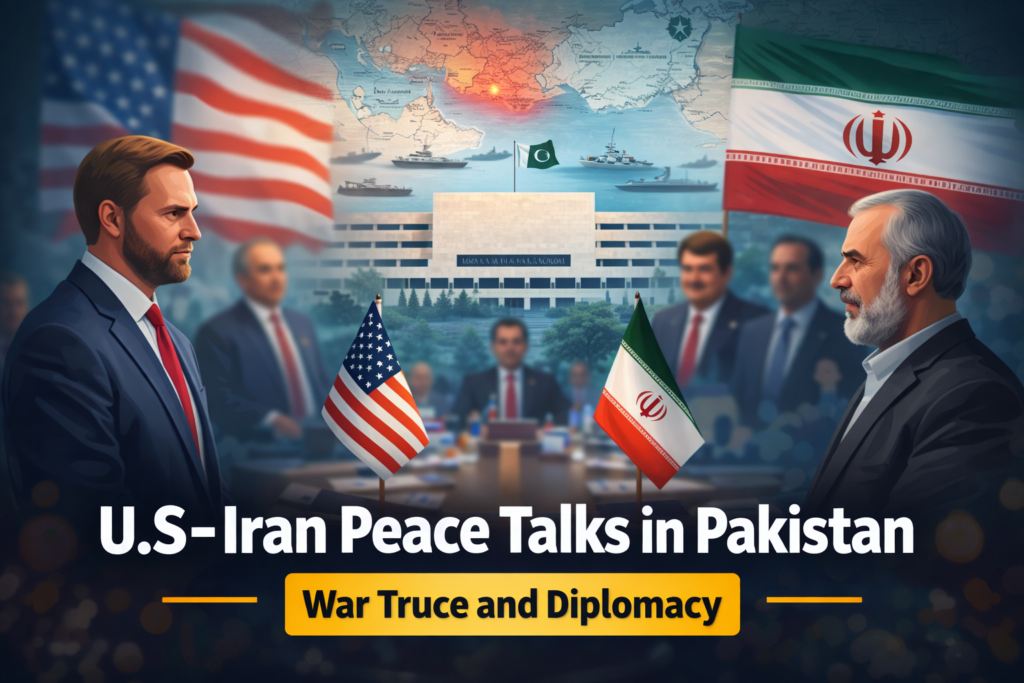
Against this backdrop, the United States and Iran entered into an extraordinary round of direct face-to-face peace negotiations hosted by Pakistan in Islamabad on April 11 and 12. Vice President JD Vance led the U.S. delegation. The talks lasted more than 21 hours — an indication of just how complex and entrenched the disagreements between the two sides had become.
In the end, they failed. The sticking points were fundamental. Iran’s demands included control of the Strait of Hormuz, payment of war reparations, a ceasefire across the entire region including Lebanon, and the release of its frozen assets abroad. Iran also refused to abandon its nuclear enrichment program. The United States was unwilling to accept Iran retaining a path to a nuclear weapon — a position Trump has described as a red line. “After 21 hours of negotiations, the Iranians chose the pursuit of a nuclear weapon over peace,” Trump said in a statement following the collapse of the talks.
“THIS IS WORLD EXTORTION, and Leaders of Countries, especially the United States of America, will never be extorted.” — President Donald Trump, Truth Social, April 13, 2026
Vance, speaking in Islamabad after the talks collapsed, left the door slightly open to further negotiations: “We leave here with a very simple proposal. We’ll see if the Iranians accept it.” But any remaining hope for a quick diplomatic resolution evaporated the following day, when Trump announced the blockade.
Trump Announces the Blockade
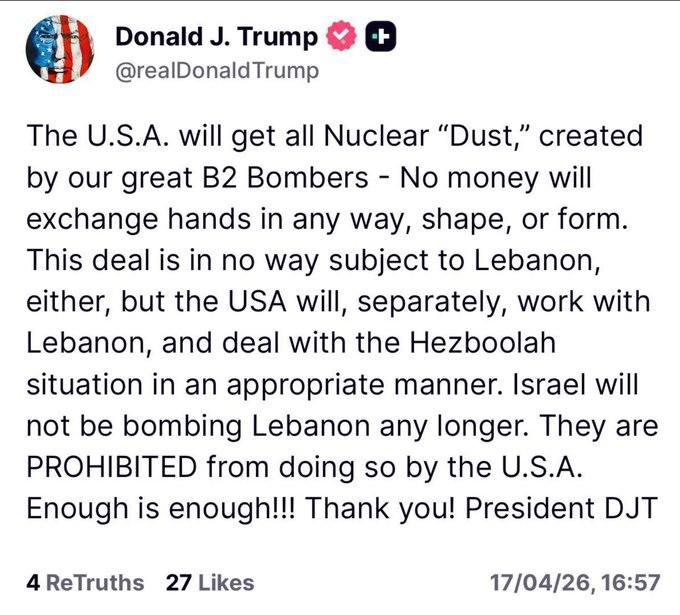
On Sunday, April 13, President Trump posted on Truth Social that the U.S. Navy would immediately begin blockading “any and all Ships trying to enter, or leave, the Strait of Hormuz.” He further announced that U.S. forces would “seek and interdict every vessel in International Waters that has paid a toll to Iran,” calling Iran’s practice of charging ships for safe passage “WORLD EXTORTION.”
The blockade officially went into effect at 10 a.m. Eastern Time on Monday, April 14. However, U.S. Central Command (CENTCOM) quickly clarified the scope of the action: it was not a full blockade of all traffic through the strait itself. Rather, it was a blockade of Iranian ports and coastline specifically. “The U.S. action is a blockade of Iran’s ports and coastline, not a blockade of the Strait of Hormuz,” Joint Chiefs Chairman General Dan Caine said at a Pentagon press briefing Thursday. “It applies to all ships, regardless of nationality, heading into or from Iranian ports.”
CENTCOM also announced that U.S. forces would actively pursue “any Iranian-flagged vessel or any vessel attempting to provide material support to Iran” in other areas — including so-called “dark fleet” vessels that operate outside normal shipping regulations to evade sanctions.
The blockade and ongoing disruption to the Strait of Hormuz have real consequences for everyday Americans. Oil prices above $100 per barrel translate to higher gas prices at the pump. Airlines have already begun cutting routes and trimming schedules due to rising jet fuel costs. Grocery prices are also affected, as food production and transportation depend heavily on fuel and petrochemical inputs like fertilizer.
The Trump administration issued a sanctions waiver for Russian oil, allowing G20 countries to buy Russian crude without facing U.S. penalties — a move designed to increase global oil supply and ease price pressure during the Iran crisis.
How Many Ships Have Been Turned Back?
Within 24 hours of the blockade beginning, the Pentagon reported that 10 ships had been turned back. By Thursday, April 17, that number had risen to 13. The U.S. military also declared that the blockade had been “fully implemented” and that U.S. forces had “completely halted economic trade going into and out of Iran by sea.”
Before the blockade even went into effect, vessels were already steering clear. Real-time ship tracking data provided by maritime analytics firm Kpler showed significantly fewer ships in the area around the strait compared to the days prior, as shipping companies preemptively rerouted their fleets to avoid the confrontation zone.
Enforcing the blockade is a legally complicated and operationally challenging mission. Andreas Krieg, a senior lecturer at King’s College London’s School of Security Studies, described it as “less like a clean historical blockade and more like a messy, high-risk interdiction regime.” U.S. forces must identify, track, hail, divert, and potentially board vessels linked to Iranian ports, all while operating in one of the most crowded and politically sensitive waterways in the world.
Iran’s Response: Threats and Countermoves
Iran has not accepted the blockade quietly. The Islamic Revolutionary Guard Corps (IRGC) warned that any military vessels approaching the strait would be considered a ceasefire violation and would receive “a firm response.” Iran’s armed forces described the U.S. blockade as “piracy.” Iran’s foreign minister threatened to block shipping from the Persian Gulf, the Sea of Oman, and the Red Sea if the U.S. continued its action and created “insecurity for Iranian commercial ships and oil tankers.”
Geopolitically, Iran received some support. China, which relies on Iran for approximately 20% of its oil and routes more than half its total energy supplies through the strait, labeled the U.S. blockade “dangerous.” China and Russia had previously vetoed a U.N. Security Council resolution encouraging member states to work toward reopening the Strait of Hormuz. However, Trump later said that President Xi Jinping had agreed not to send weapons to Iran, and Trump claimed China was “very happy” that the U.S. was working to permanently open the strait.
The Ceasefire: A Fragile Lifeline Running Out of Time
Adding to the complexity is a fragile two-week ceasefire that came into force on April 8, 2026, after Trump threatened to “wipe out” Iran’s “whole civilization” if it did not reopen the waterway. That ceasefire is set to expire on Wednesday, April 22 — just four days from now.
As of Friday, April 18, Trump signaled he may not extend it. “Maybe I won’t extend it,” Trump told reporters aboard Air Force One late Friday night. “But the blockade is going to remain. But maybe I won’t extend it, so you have a blockade, and unfortunately, we’ll have to start dropping bombs again.”
On Friday, Iran’s foreign minister announced that, for the duration of the ceasefire, “passage for all commercial vessels through Strait of Hormuz is declared completely open” via a designated route through the vital shipping lane. Trump responded by saying the U.S. blockade would remain in place regardless. “The blockade is going to remain,” he reiterated.
Pakistan has said it expects to host a second round of U.S.-Iran negotiations, though no date or location has been announced. French President Emmanuel Macron announced a conference at the Élysée Palace — co-chaired with British Prime Minister Keir Starmer — focused on coordinating maritime traffic in the Strait of Hormuz once the war ends.
A Timeline of Key Events
U.S. and Israeli forces begin strikes on Iran. Tehran responds by restricting access to the Strait of Hormuz and warning of mines in the shipping lane.
China and Russia veto a U.N. Security Council draft resolution encouraging countries to work to reopen the Strait of Hormuz.
A fragile two-week ceasefire between the U.S. and Iran comes into force after Trump threatens to destroy Iranian infrastructure.
VP Vance leads U.S. delegation for marathon negotiations with Iran. Talks collapse over Iran’s insistence on nuclear program and Hormuz control.
Trump posts on Truth Social announcing a blockade of the Strait of Hormuz. CENTCOM later clarifies the blockade targets Iranian ports specifically.
U.S. Navy begins enforcement. Iran calls it “piracy” and threatens retaliation. Shipping companies reroute vessels preemptively.
The U.S. military declares the blockade fully operational. Iran announces Hormuz is “completely open” for the duration of the ceasefire, but Trump says the blockade stays.
The two-week ceasefire is set to expire. Trump has signaled he may not extend it. Without a deal or extension, military strikes could resume.
What Happens If the Ceasefire Expires Without a Deal?
This is the question every analyst, diplomat, and energy market trader is watching closely. If the ceasefire expires on April 22 without either an extension or a permanent peace agreement, Trump has indicated military strikes on Iran could resume. He told reporters he would “hate to do it” but raised the prospect of hitting Iran’s desalination plants, electric-generating facilities, and other critical infrastructure.
Iran has warned it would respond to any resumption of strikes by blocking shipping from the Persian Gulf, the Sea of Oman, and the Red Sea — a move that would dramatically expand the economic disruption beyond what the world has already seen. The IRGC’s framing of any military vessel approaching the strait as a ceasefire violation adds further risk of accidental escalation in a waterway already on a hair trigger.
For American consumers, the economic stakes are clear and immediate. Gas prices, airfare, grocery bills, and the prices of goods that travel by ship — which is to say nearly everything — are all sensitive to what happens in the Strait of Hormuz over the next 96 hours. The world is watching.
The Bottom Line: What You Need to Know
The Iran war and the blockade of the Strait of Hormuz represent the most significant U.S. military action in the Middle East in years — one with profound consequences for global energy security, international law, and everyday American household budgets. The ceasefire expires April 22. Peace talks have failed once. The Navy has turned back 13 ships. Oil prices are elevated. And the world’s most critical shipping lane hangs in the balance.
This is a developing story. Check back for updates as the April 22 ceasefire deadline approaches.
Sources: CNBC (April 12, 13, 16, 2026); NBC News live blog (April 16, 2026); CBS News live updates (April 18, 2026); NPR (April 13, 15, 16, 2026); TIME (April 12, 2026); Pentagon press briefing (April 17, 2026).
Disclaimer: This article is for informational purposes only. This is a rapidly developing situation — details may change. Always consult trusted news sources for real-time updates.